
Soundlings: An interactive sound toy
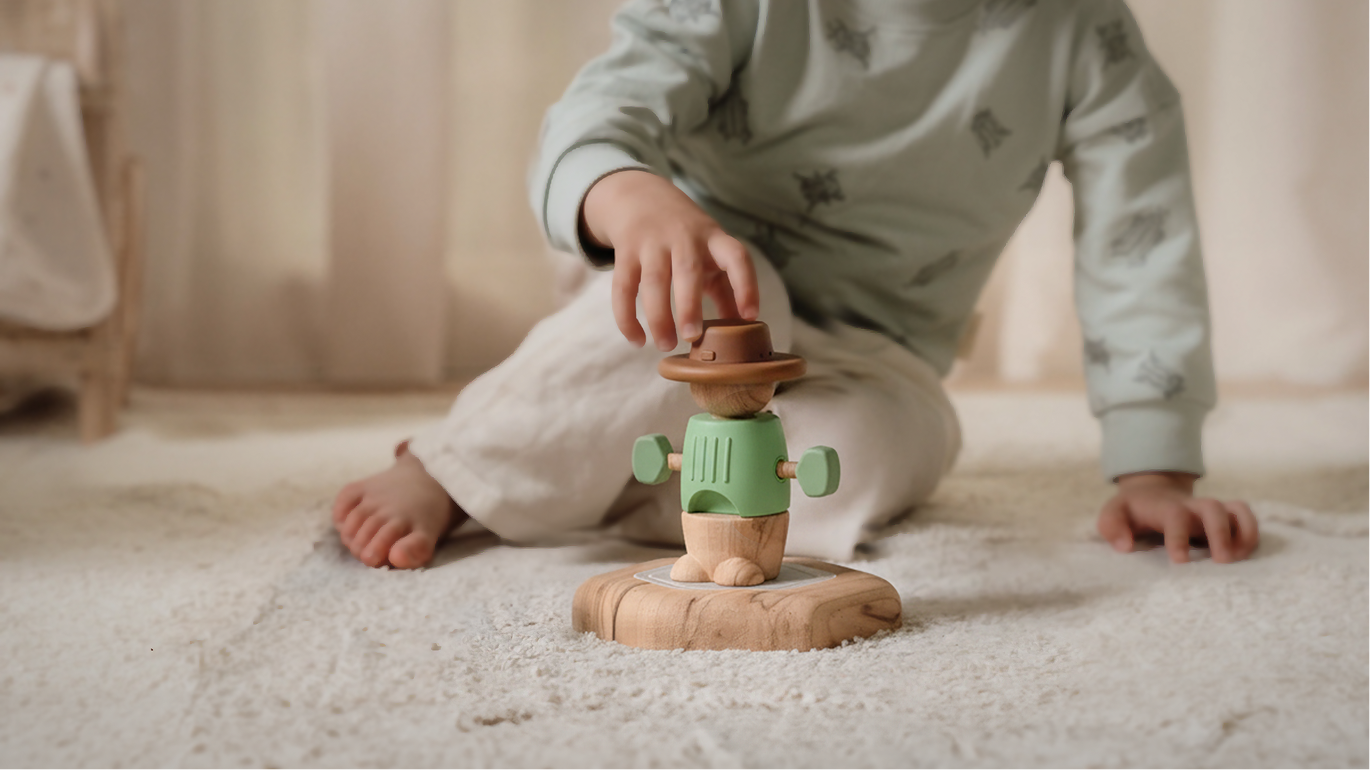
Soundlings is a motor development toy for children aged 3-5. The main concept of Soundlings is to provide varied sound feedback through children’s interactions with the toy. Each part of Soundlings has a unique sound role; melody, instrument, or sound effect. These parts encourage children to actively engage with the toy while enhancing muscle control and fine motor skills, all while having fun!
Team
Thorben WestendorfChenyu DongCheolhun Cheon
and me
Timeline and place
3 weeks, 2025
Umeå Institute of Design

Everything about Soundlings
This is our concept video that you can learn about Soundlings.
Form Design
Modelling and rendering by
Thorben Westendorf, Chenyu Dong and Cheolhun Cheon
Three parts of Soundlings
Soundlings consist of three main parts: leg, body and head. Each have its own sound role as melody, instrument and sound effect. Also with a base part that functions as a speaker.
Different interactions for each modules
Each module is designed to provide different types of interaction to enhance various motor skills.
Pressing
Twisting
Pushing
Rotating
Rolling
Bending
Sound Design
Sound design and video editing by Eonbi Hong
Operational sounds
We have 5 operational sounds: power on/off, volume up/down, and connection sound feedback.
An important rule for operational sounds is to use a single tone for simplicity. Since we have 30 different melodic sounds for the toy, we aimed to design simple and clean operational sounds.
- Power on/off
- Volume up/down
- Connection feedback
- Leg: Three basic melodies
Each leg module has a different melody. Soundlings will be activated by placing a leg module on the base part, so each melody will be a basic sound to start with.
- Body: Change instrument sound
Each body modules have its own instrument sound such as piano, guitar and drum(marimba).
- Arm movement: Changes in melody
Also, interacting with arms provides different sound feedback. By tweaking arms, some notes will be either added or removed. With a simple rule, we can easily create variations.
- Head: Sound effects
Each head module has 2-3 sound effects in its own theme. An important rule for the sound effect was to make the sound different, while maintaining consistency in the feeling of each theme.
- Harmonised sound
At the beginning of the sound design process, we aimed to make all sounds harmonised. Therefore, due to melodic rules and the similar tones of instruments, different sounds blend smoothly.
A glimpse of our process
What I’ve learned
Ableton Live and other sound softwares
During this project,
I learned to use Ableton Live, Adobe Audition, and Vital which also opened up interesting possibilities for future projects.
Cross-Field Teamwork
Working in a team with industrial designers helped me understand different perspectives. It thought me to balance different values.
Impact of sounds
I had a chance to fully experience the impact of sounds. Also, it was a good practice to sharpen my senses and became more aware of subtle sound effects.
Click to read more
Final words
It was an enjoyable project where I designed sound and interaction in relation to a physical form. It made me reflect on how powerful sound can be in shaping user experience. Also, working with people who had different values and perspectives toward the product and user experience helped me practice finding balance, communicating my ideas more effectively, and understanding different viewpoints.

Back
Back
Soundlings: An interactive sound toy
Soundlings is a motor development toy for children aged 3-5.
The main concept of Soundlings is to provide varied sound feedback through children’s interactions with the toy. Each part of Soundlings has a unique sound role; melody, instrument, or sound effect. These parts encourage children to actively engage with the toy while enhancing muscle control and fine motor skills, all while having fun!
Team
Thorben WestendorfChenyu DongCheolhun Cheon
and me
Timeline and place
3 weeks, 2025
Umeå Institute of Design

Everything about Soundlings
This is our concept video that you can learn about Soundlings.
Form Design
Modelling and rendering by Thorben Westendorf, Chenyu Dong and Cheolhun Cheon
Three parts of Soundlings
Soundlings consist of three main parts: leg, body and head. Each have its own sound role as melody, instrument and sound effect. Also with a base part that functions as a speaker.
Different interactions for each modules
Each module is designed to provide different types of interaction to enhance various motor skills.
Pressing
Twisting
Pushing
Rotating
Rolling
Bending
Sound Design
Sound design and video editing by Eonbi Hong
Operational sounds
We have 5 operational sounds: power on/off, volume up/down, and connection sound feedback.
An important rule for operational sounds is to use a single tone for simplicity. Since we have 30 different melodic sounds for the toy, we aimed to design simple and clean operational sounds.
- Power on/off
- Volume up/down
- Connection feedback
- Leg: Three basic melodies
Each leg module has a different melody. Soundlings will be activated by placing a leg module on the base part, so each melody will be a basic sound to start with.
- Body: Change instrument sound
Each body modules have its own instrument sound such as piano, guitar and drum(marimba).
- Arm movement: Changes in melody
Also, interacting with arms provides different sound feedback. By tweaking arms, some notes will be either added or removed. With a simple rule, we can easily create variations.
- Head: Sound effects
Each head module has 2-3 sound effects in its own theme. An important rule for the sound effect was to make the sound different, while maintaining consistency in the feeling of each theme.
- Harmonised sound
At the beginning of the sound design process, we aimed to make all sounds harmonised. Therefore, due to melodic rules and the similar tones of instruments, different sounds blend smoothly.
A glimpse of our process
What I’ve learned
Ableton Live and other sound softwares
During this project,
I learned to use Ableton Live, Adobe Audition, and Vital which also opened up interesting possibilities for future projects.
Cross-Field Teamwork
Working in a team with industrial designers helped me understand different perspectives. It taught me to balance different values.
Impact of sounds
I had a chance to fully experience the impact of sounds. Also, it was a good practice to sharpen my senses and became more aware of subtle sound effects.
Hover to read more
Final words
It was an enjoyable project where I designed sound and interaction in relation to a physical form. It made me reflect on how powerful sound can be in shaping user experience. Also, working with people who had different values and perspectives toward the product and user experience helped me practice finding balance, communicating my ideas more effectively, and understanding different viewpoints.